

Ring of Fire (13 days by a volcano)
(.)To look up. To look ahead. Elevations, schematic triangles, depressions and valleys. Movement and stasis. Looking down. Accumulation, patience, time. The constitution of earth itself, its landscapes, contours, lines. Fire, destruction and vitality. Density and fragility. Drunkenness and mayhem. (..) A. writes a letter. After morning coffee and an inordinate amount of sugar. Get’s on the bike to cover the distance in good time. M. sat by the giant old record player, sorting through old vinyls bought in London in the 1960s. Some late 1950s song by The Three Suns, volcanoes synonymous with sun, sea and coconut water. (…) Lowry’s Under the Volcano, opens with a description of mountains and volcanoes; he’s in a place on the 19th parallel, to be exact. The book’s tale, infused with alcohol and cigarette smoke welcomes the volcano as the character’s terrifying other: “Nothing but pines, fircones, stones, black earth. Yet that earth looked parched, those stones, unmistakably volcanic. Everywhere, quite as Prescott informed one, were attestations to Popocatepetl’s presence and antiquity. And here the damned thing was again! Why were there volcanic eruptions? People pretended not to know. Because, they might suggest tentatively, under the rocks, beneath the surface of the earth, steam, its pressure constantly rising, was generated; because the rocks, and the water, decomposing, formed gases, which combined with the molten material below; because the watery rocks near the surface were unable to restrain the growing complex of pressures, and the whole mass exploded; the lava flooded out, the gases escaped, and there was your eruption. – But not your explanation. No, the whole thing was a complete mystery still. In movies of eruptions people were always seen standing in the midst of the encroaching flood, delighted by it. Walls fell overs, churches collapsed, whole families moved away their possessions in a panic, but there were always these people, jumping about between the streams of molten lava, smoking cigarettes….” (….) Filmmakers make lists (…..) Tazieff wrote about tectonic plates and volcanic activity. The language is matter of fact, analytical, informative but poetic as well. Crust, riff, faults, mosaic, synclinal, folds, intumescent, seismic, oceanic, primary and secondary volcanism are just some of the captivating words used to explain geology and geomorphology in his Making of the Earth: Volcanoes and Continental Drift. In his 1966 film, Le Volcan Interdit, he climbs the Niragongo, to climb down its crater, a home of sorts for the volcanologist, a peak into the Earth’s mantle, attempting to systematise the compositions of what sustains us. (……) Johnny Cash’s Ring of Fire playing on repeat. The ring of fire, a volcanic belt that frames the Pacific Ocean. (…….) M. reads a book that describes an anthropologist’s terrifying encounter with a bear in Kamchatka while climbing a volcano. The mountain curved against a cloudy sky and the rock felt brittle under her feet. She found no fault with it. Around the volcano, the encounter between human and bear becomes the place where world perceived as separate in fact show their contiguity. (……..)
A. is thinking about making a film with a volcano as a central motif. What possible connection can you have with a mountain of fire and how to transpose it to film avoiding the enthralling spectacular moments of a volcanoes’ cycle? Moyra Davey’s opening sequence in Notes on Blue, keeps coming back: “I began with a first note to myself. I made a list. But I’ll start in the middle with Blue Ruin, a one minute movie shot on outdated film stock about a woman at the end of the day threading her bra out from under her t-shirt, while pouring a shot of gin from the freezer.” (……….) A perpetual crumbling and renewal. Volcanoes are polysemic. (………..) The night falls. A. and M. measure their distance to the volcano. A camera to film, a seismograph to read the volcano’s love letters. (…………)
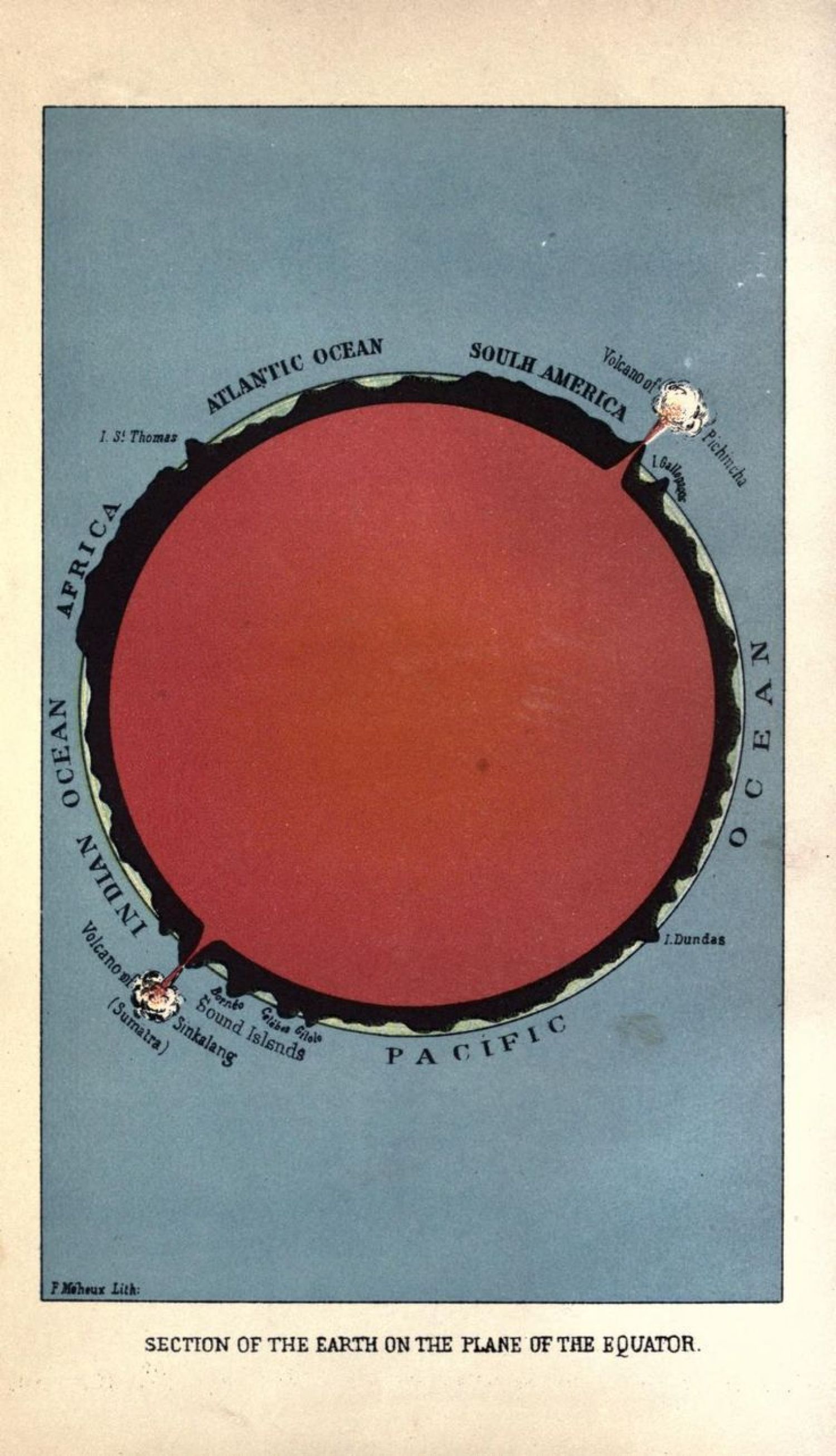
A cross-section of the Earth at the equatorial plane, produced by the lithographer F. Meheux in the 19th century. It illustrates previous geological like plutonism and the hypothesis that in the beginning the Earth was molten lava covered by a layer of crust. (………….) The image burns. The film strip is done. John Ashbery. “Another go-round? No, but the last things you always find to say are charming, and rescue me before the night does. We are afloat.” “Les hommes à leurs heures perdues”, wrote Anne Carson.