

#2 – Silence
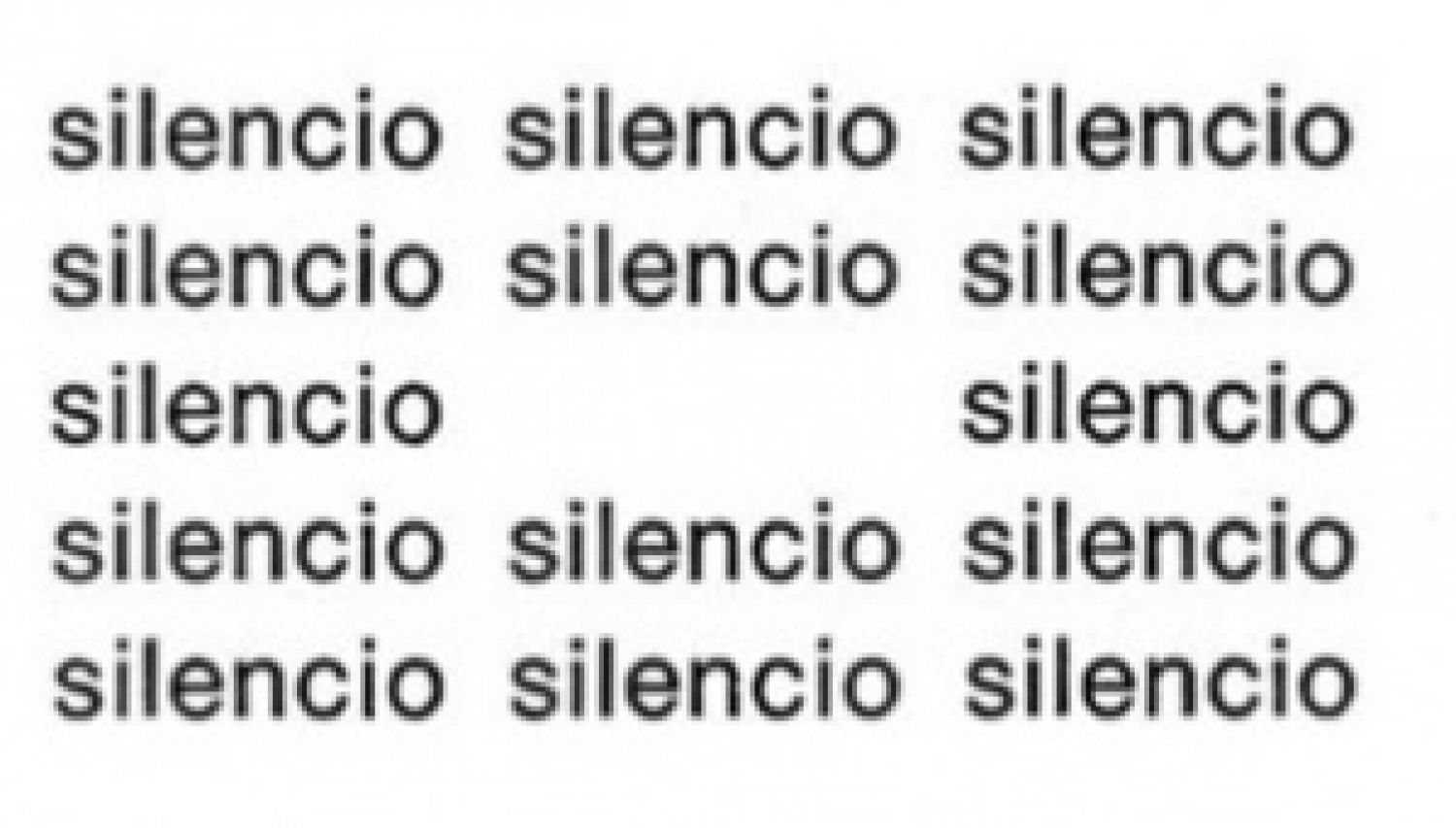
The thinking about nothingness proposes a change in the regime of attention – instead of attention to things, it prefers the space between them; instead of the surface, the crack; instead of the property, the wasteland; instead of the thing, the desire for the thing; instead of the ring, the ringed opening; instead of the walls, the slits; instead of the wall, the fissure; instead of sound, the silence, or the intermittent sound, with silence inside.
In the 1953 poem Silencio, by Swiss-Bolivian poet Eugen Gomringer, silence is not in any of its fourteen words; silence is that hole in the middle. But that hole would not be possible or visible without the noisy wall around it. Only then did that aphonic cloister become intelligible.
Silence is a hole in the continuous sound track. Like the hole in a doughnut (like the hole in that doughnut-poem), it has a peculiar existence. In fact, the hole in the doughnut does not properly exist — that is, it is not a thing; all of it is a bun. The hole has nothing, only appearance — the bun gives it a shape and therefore a virtual existence. We cannot isolate the hole in the doughnut, separate it from its sweet host; we cannot cut the hole in half and obtain two halves as with all things that are, for a hole is always whole. In the same way, we cannot eat the doughnut and not eat the hole (ideas from Kurt Tucholsky, Achille C. Varzi, among others). There are things that exist and are not seen, and things that do not exist and are seen; holes belong to this latter group. The same applies to the horizon, which is seen and does not exist, or to the border, which exists and is not seen.
Sound is matter and silence is the absence of it; therefore, silence is not heard because there is nothing to hear, there is nothing; thus, silence is a hole and, in order to exist (as difference), it needs adjacent matter just as a parasite needs a host.
The letter “h” has a name and a shape but has no sound of its own — it is the silent letter, the hole in the middle of the alphabet; it works like a successive contrast — it influences what is adjacent to it, like punctuation or a stage direction, which spread without actually making noise. If there is a letter for silence, it is “h.”
Unlike Gomringer’s precise poem, where silence is surrounded by noise, one might think that it is silence that surrounds everything that is noisy, appearing whenever sound ends; as one reads in a short essay by Lydia Davis: «[N]ow I live in a quiet place, at the edge of a small village in a rural area, on a road that is less traveled. At night, sometimes, or in the late evening, there is an enveloping silence.» Silence as something that surrounds something else, like a glove, a muffling silence. «Silence is like a damp cloth: it removes the dust without making it fly.»(Quignard)
«El silencio en una casa es como dejarse el gas abierto.» (Lucía S. Sobral) That is, in silence, what one does is listen to what may arise from silence.
[Next text: Limits]