[HD video, 16:9, colour, sound, 70 mins]
an exhibition-video installation, conceived in 2024 at the invitation of Aveiro 2024 – Portuguese Capital of Culture and presented during June and July in the Studio Hall of the Teatro Aveirense, Aveiro.
«…depois de pulsar mais uma vez com os sentidos todos a terra em redondo»
(‘…after once again taking in the surrounding landscape with all my senses’)
Portugal, 20th century, 1940s: mining was expanding in the central and northern regions of the country, with a particular focus on tungsten, a mineral used in the production of steel and other metal alloys, which was essential for the manufacture of armament.
With Portugal under a dictatorial single-party regime and Europe in turmoil, in the midst of the Second World War, Salazar attempted, through diplomatic manoeuvring, to reinforce Portugal’s neutrality in the conflict, but ultimately negotiated the mining and sale of tungsten with both the Germans and the Allies.
The title of this original work – a video installation and exhibition, originally produced for Aveiro 2024 – Portuguese Capital of Culture – draws on a phrase from Aquilino Ribeiro’s novel Volfrâmio, published in 1943. Certain archive images featured in the video and in its complement edition are taken from a periodical, the newspaper O Pejão, produced in the 1950s by the Empresa Carbonífera do Douro, which managed the Pejão Mines, situated in the district of Aveiro.
This project continues the exploration of the memory of labour and its workers, as seen in the work Operários da Metalúrgica Alentejana (1995), which engaged in dialogue with former metalworkers from that factory, or in Se estou meio morto é porque estou ainda meio vivo. (2020), created in collaboration with Avieiro fishermen (Tagus River stilt-village fisherman), an installation displayed at the entrance to the Museum of Neo-Realism. Also the curatorial projects COLLECTING COLLECTIONS and CONCEPTS, Uma viagem iconoclasta por coleções de coisas em forma de assim, an exhibition-installation from the official Art and Architecture programme of Guimarães 2012 European Capital of Culture, ENSAIO PARA UMA COMUNIDADE — Retrato de uma coleção em construção (take 1) (2021–22) at the MAAT Museum of Art, Architecture and Technology, and TRABALHO CAPITAL #1, #2, (2019–2020), in which I worked with former workers from the Oliva industrial complex, reveal this concern with making the concept of labour operational and affirmative in the conception, production and installation of artworks within a critical and disruptive context that may arise in the sphere of contemporary art discourse.
Mining communities are hurtling from paradise to rage with the speed of a descent into the deepest tunnels. There is no heroism in the hunger and despair caused by poorly paid work carried out in appalling conditions, nor in the exploitation of a people’s physical and moral strength and dignity.
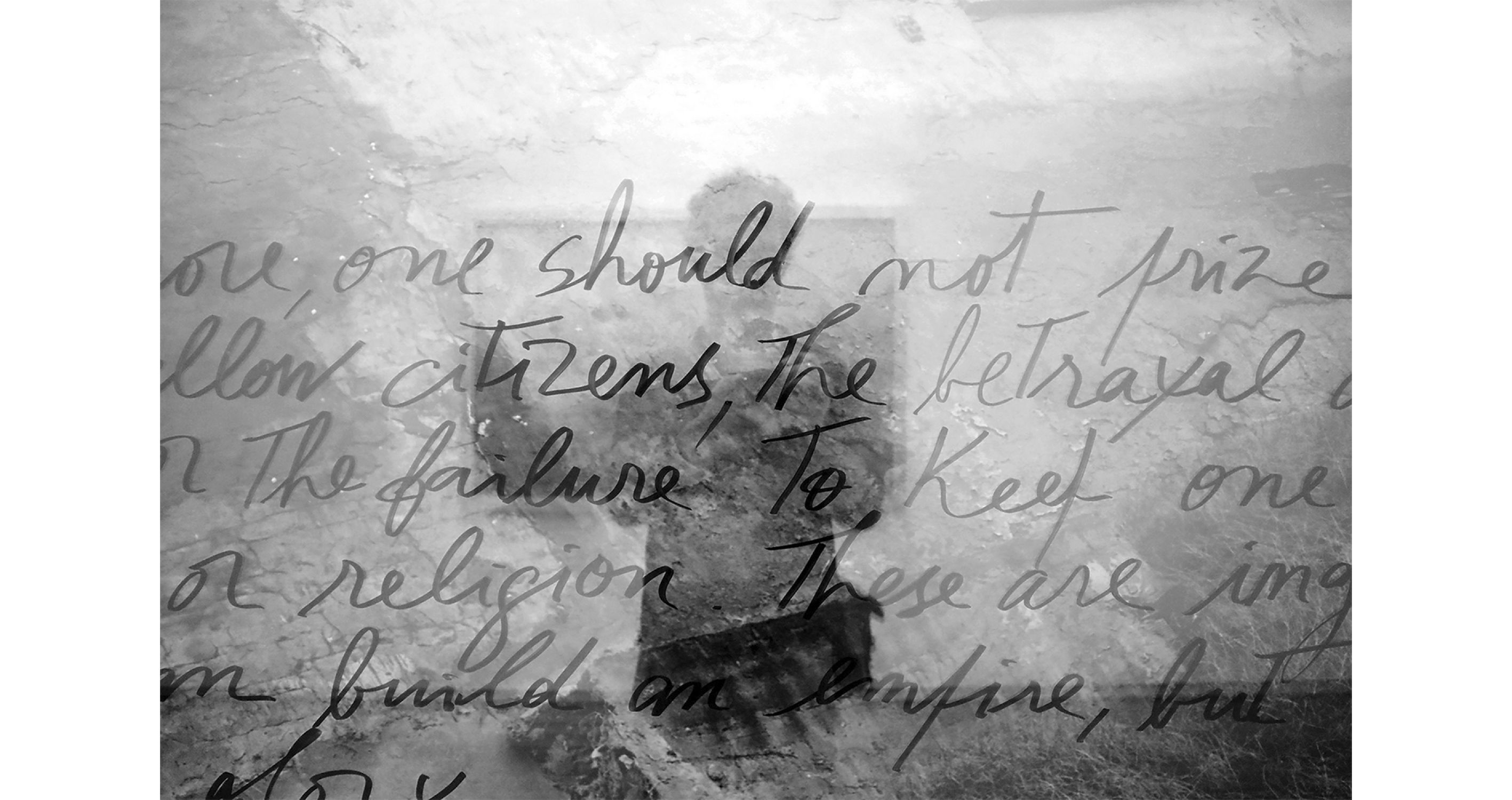
The images and crossed-out texts, featured in the video and in the publication that complemented the screening of the video, bear witness to the paternalistic discourse and propagandistic iconography of a fascist dictatorial regime, conceived by the Government of the Nation and interpreted and disseminated by the subjects who served it faithfully.
The remaining industrial ruins stand as a monument in the present day to the uncivilised nature and impotence of an economic model based on unbridled extractivism, with no regard for the community or nature.
The spectral image of a former miner drifts through the countless tunnels of Portuguese and international mines. The long static shots create a slowing down of time in the face of the maelstrom of memory. The editing accentuates what lies off-screen, between the shots; it fragments into a construction of collective historical, social and political memory, revealing the echoes of a tangible and intangible heritage – ghostly spaces temporarily filled by the presence and voice of a former miner, who activates this industrial space and its colossal temporal machinery.
Paulo Mendes, 2024
« Even from a great distance—five hundred to a thousand metres away—you could see people: women washing the mineral-rich earth in the open air and under lean-to shelters, their arms rolled up, their feet bare, their skirts gathered between their knees so the water wouldn’t splash up their legs. Young lads, wearing men’s berets, faded from constant wear, their tender flesh peeking out from shirts full of patches and in tatters, were coming up the hill to empty the cart crammed with stones, in which the pyrite and tungsten flakes glistened in the sun. Further afield, a large crowd of men were digging a trench, whilst another group, heading up the hill, was carrying a load of stone and gravel using iron picks and mattocks. Here and there, workers were chiselling away at the rock, whilst others were tasked with carrying charges of blasting powder. Clutching the handles of their winches, many were drawing the slurry from the shafts or draining the water from them so that the work could proceed efficiently. It was underground, sometimes dozens of metres deep, that the mine’s main activity took place, with compressed-air drills breaking up the quartz, teams of specialist shoring men reinforcing the tunnels, electric and hand-operated pumps drawing water from the drainage channels and spoil heaps, miners with pick and hammer, men upon men loading and unloading — a complex workforce, tough and skilled in their craft. On the surface, it was like a fairground. Amidst the shouts, commands, jumbled chatter, the clanging of tools and the clattering of wagons and trolleys, the dynamo pulsed, and its dull, deafening thud created that special, semi-barbaric and ferocious atmosphere of modern industry, man and machine working in unison. »
in Aquilino Ribeiro, Volfrâmio, 1943.