In the mid-50s, the British company DuPont Polyester Chemical Industries developed Mylar; at that time, they were undoubtedly aware of the technological – and far from ecological – revolution they might be instigating. It is very likely that they foresaw its long-term durability, which has made it the most widely used solution (to date) for packaging and thermal storage. However, I imagine they could hardly have predict that it would become a raw material for artistic and performative research, as Luísa Mota has been doing since 2009.
Myself, as a child, so far removed from all of this facts, I would insist with my mum to buy whole boxes of the legendary Capri-Sun, at the supermarket nearest to my mountains. I never imagined that this product would once again captivate me with such enthusiasm and magic. (To be honest, I never found the flavour particularly special, but rather the packaging itself, made partly from Mylar – years have passed – and I’m always delighted when I come across to a new flavour or design on Capri-Sun cartons.)
When Luísa challenged me to explore a solo performance of Crystal Beings – to let myself go – something about that invitation (and the material) struck me as strangely familiar, despite the surprise and unpredictability of the situation itself. Crystal Beings are silent yet strident characters in their metallic sounds, resonating as they move in their Mylar suits\cloaks. They function as amulet-mirrors, activating collective processes of thought around invisibility – What does it mean to be invisible? What reflects our invisibility? Who are the invisible ones? How is invisibility performed?
This costume, this second skin, is thus a magical cloak, a protection, an invisibility, a reflection of ourselves and of the context in which it is being worn, moved and performed.
How to not be seen? A fucking didactic educational MOV file by Hito Steyerl was the artistic creation that (immediately) came into my mind, when I start to answer to this invitation and to be in contact with the costume itself and its material. Crystal Beings bring to the surface questions about the act of staging\directing invisibility whilst being highly perceived.
Metaphorically speaking – it is like conducting online searches in an incognito browser, trying to be invisible when, even so, this IP address remains under surveillance, visible and strongly monitored.
Luísa, like Hito, provides us with instruction manuals – which we might also call trial-and-error methodologies – for rethinking invisibility. In an age where there is no time to waste and where the litres of water in our bodies dissolve amidst algorithms, Wi-Fi connections and the cooling systems of artificial intelligence data centres.
Hito in MOV file highlights five lessons on how not to be visible; in lesson number four, invisibility is achieved through a practice of disappearing, which, as she herself states: «living in a gated community; living in a military zone; being at an airport, factory or museum; wearing an invisibility cloak; being a superhero; being a woman over 50; browsing the deep web; being a dead pixel; being a Wi-Fi signal moving through bodies; and being a missing person as an enemy of the state.» On a sunny Tuesday, I went to Luísa’s studio and followed the Beings’ instruction manual, and practised the disappearance – I dressed an invisibility cape (a Mylar suit), and became a superhero, a missing person, without identity, unidentifiable, and almost navigated the deep web of unknown places I accessed.
The Crystal Beings instruction manual begins with an idea of enchantment, I explored the material fabric and the invisible protection to which it transports us. These performance characters embody, within their instructions, individual and collective empowerment through the magical ritual of encounter. They contain paradoxical symbolisms, vague, abstract and even somewhat obscure, capable of activating multiple layers of perception. In Crystal Beings, the invisibilities and subtle energies they activate form a vibrant structure that shapes the experience of both the performer and the «spectators», activating this threshold between the visible and the inaudible, between the real and the imagined. The obscurity in Luísa’s work is not an absence, but a strident presence, which challenges perceptions of the occult and provokes a constant sense of mystery in friction with discovery.
That morning, I tried the experiment and put on the costume with the help of Rafaela, Luísa’s studio producer – who carefully guided me on the need to move calmly, with intention and a degree of caution in my breathing, making the whole process feel even more intense and deeply ritualistic. I dressed from the bottom up, starting by wrapping my feet in rectangular strips of this crystallised cloak — these looked like festive sweets, ready to be eaten at some moment of celebration or sugar craving. Putting on the rest of the outfit was somewhat like changing into a work uniform, a second skin, from discomfort to a perfect fit. We finished with what we might call a cybernetic helmet (from another world), also made of Mylar, which completely covered my head.
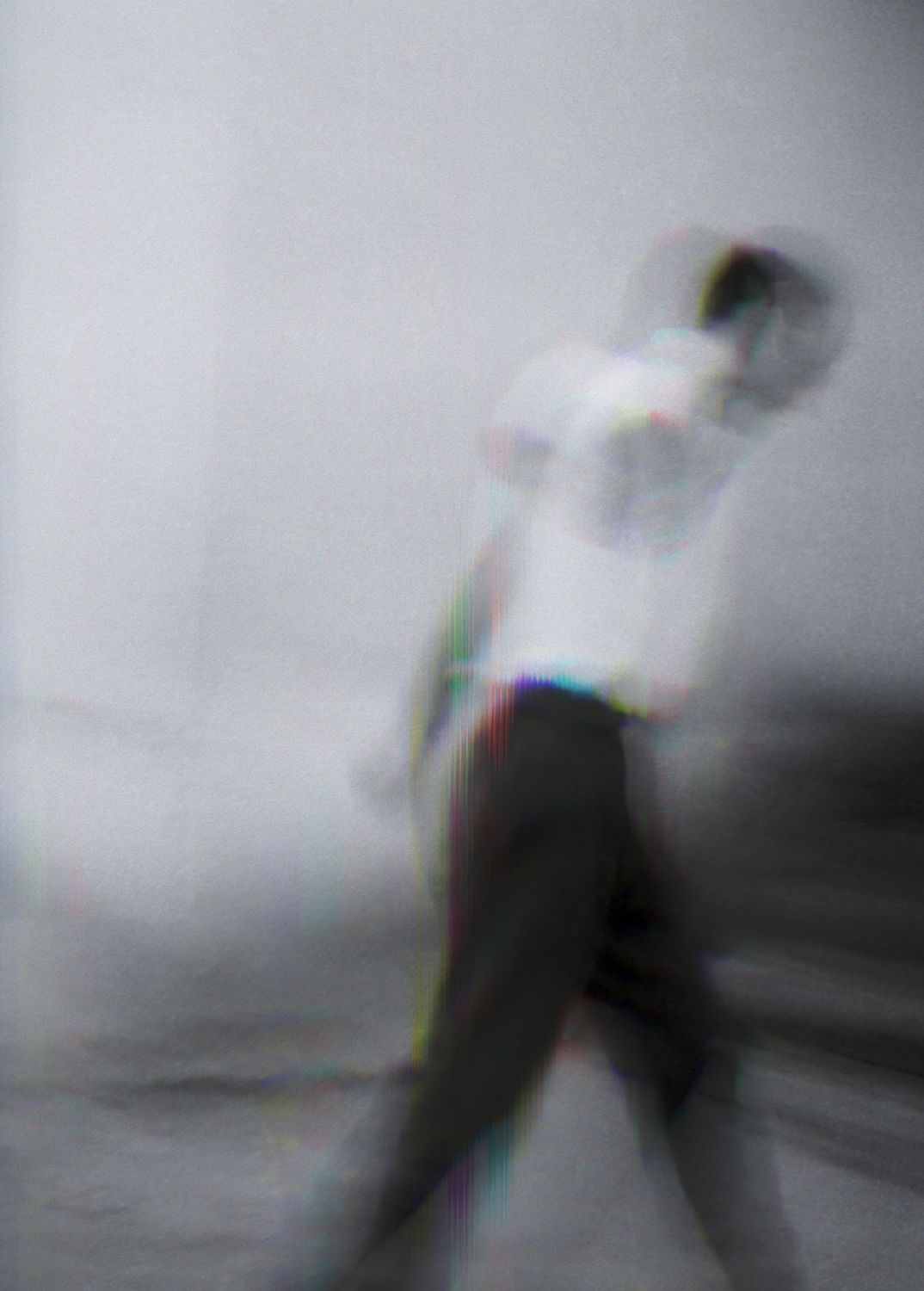
There is a certain degree of confusion associated with becoming completely unrecognisable: when I say «completely», I mean it, since not a single millimetre of you or your skin is perceptible, visible, accessible, comprehensible, intelligible or clear to the eyes of others. The only way to see without the distortion caused by the Mylarised vision — a blurred and, at times, holographic effect caused by the cybernetic helmet — is through a narrow slit, when you focus your gaze on the floor. I emphasise this. The Mylar cloak is made of polyester resin — a very thin, transparent plastic — produced by melting resin and stretching it biaxially (in two directions). This process creates a unique Mylarised transparency — which is sometimes blurred and sometimes holographic. It is possible to see through this Mylar cloak, but this vision appears as a «glitch» — a distortion, a break in perception, a fractal, just like the metaphorical meaning of these characters.
Now, I was a fractal mirror, a second skin of discomfort, a discomfort that was thermal, sonic, and tactile, caused by the body’s tension against the almost rigid material: broken, metallic plastic. This fractal mirror effect, far more than a difficult-diffuse volumetric effect, represents a figure of non-classical geometry, often found in nature in patterns of trees, sea shells, and burrows – an object that repeats its features in an endless pattern, infinitely complex patterns created by the repetition of a simple process. In this metallic cloak, it is my movements (a simple process) that generate geometric forms of an endless and complex pattern (fractal mirror), a dynamic system, almost a representation of Chaos. I left the studio, slowly, felt the perspiration on the material, looked at the ground through the blurred vision of the helmet. I carried on.
The instructions were clear and symbolic: to hold out for as long as I could, to explore my surroundings, and to reflect what invisibility meant to me and, in effect, to become invisible. When I took my first steps outside the studio, I couldn’t help but think that, in the contemporary world, it is almost impossible – if not completely unattainable – to achieve such invisibility. Becoming invisible seems today (more than ever) an act of resistance, a form of freedom of movement and occupation of public space. Walking gently through Porto with a cloak of invisibility was, in a way, an exercise in transgression and transmutation. (I recall that the city of Porto, in recent years, has invested around 3 million euros in a high-surveillance camera system that has been fully operational since 2023 in the city’s downtown and city centre).
I began slowly to practise what the artist and sound theorist Brandon Labelle describes as: «disappearance – a body that is out there but never fully reveals itself – a deviant practice, a practice of fantasy and embodiment, an energy of superstition, where rational understanding and reasoning give way to states of alternative perception. The disappeared occupy a nebulous and difficult arena that pushes us to the peripheries of political, social and emotional thought.» It is, therefore, essential to recognise the act of resistance inherent in invisibility in this age of hyper-surveillance and hyper-connectivity, whilst also constantly reflecting on the tensions surrounding groups rendered invisible and silenced (on a daily basis) — socio-economic contexts (marginalised, exploited, precarious), domestic and care workers (healthcare or sex work), and among ethnic, racial, gender, and sexual groups of dissident subjectivities. Invisibility, more often than not, is not a choice but an imposition, in which the absence of access and rights results in: exclusion. Thus, the quest to make myself invisible carried a liberating potential and served as a reminder of the inequalities and violence that persist, and for the most part: persecute those very same invisible people.
I paused to reflect. I let myself go, I carried on… I walked down the street or indoors (not forgetting) clad in this mylarised cloak.
My invisibility was (highly) questionable; I felt as though I were in a state of anonymous, unrecognisable freedom, which had effectively transformed me into some other being—metallic, bizarre and shrill. The metallic sounds produced by the movement of the Mylar were the first gateway that had mesmerised me. I felt them like sighs that passed through me and transported me to another world of Crystal Mirror Beings, almost like Emerging Forms of Resistance and Power. I found myself entering a meditative state, intuitively, I set in motion a choreography, a play between movements and sounds that left me in a state of flow, in a sort of energetic trance and hyper-focus. Every step, every movement, a shrill and at times ridiculous symphony. Movements, harmonics, metallic sounds that intertwine and dissolve like drizzle.
I swear I felt this uniform as a potential for a self-managed, participatory noise orchestra.
I have always been intrigued and captivated by vibrant, and at times spine-tingling, sounds; this Grey Noise, caused by the plasticity of polyester, was no exception. In fact, it triggered a kind of quantum listening: a surge of energy, a focus on meditation and deep reflection — as Oliveros would say: an activist listening. I synchronised my body with the context: the Mylar suit and the public space in a highly (un)comfortable and noisy environment, something that pulled me out of the Matrix of everyday-pressure capitalist life. This moment and this reflection awakened in me not only a kind of quantum listening (a concept by Pauline Oliveros), but also an almost tangible sensation of fusion with the material. I felt part of that moment, whether through the sound entering my head, the sweat enveloping me, or even the great confusion that, like a rollercoaster, gradually took over everything.
I found myself, intuitively, searching for myself in the reflections, seeking what I visually represented — the reflection, a fractal in pieces. As I passed a small lake, I looked for myself in the water, in the distorted reflection, in the shadow I cast. A sense of disidentification awakened in me this idea of invisibility — where was I? Where was I going? And, confused, I carried on.
In these reflections, I found myself: now a mirror shattered into pieces, a fractal, an ambiguous invisibility. I could see my blurred form through this mylar-like vision: I searched for myself in the reflective mirrors of cars, window glasses, houses, shop windows, and the puddles left behind from rain on other days. I found myself in various moments of confrontation or discomfort with people who stopped, filmed, or simply walked on by; the latter assimilating my invisibility by ignoring me, rendering me invisible and failing to make me visible.
The Mylar-like vision made my senses falter a little; looking at the sky through a Mylar veil can be almost hallucinatory, but not always comfortable or concrete. I lay down on the ground, looked up, and lost myself in the optical illusions. I carried on.
It was official, it was now, invisible to some and highly questionable to others. Almost a fractal mirror: I reflected within myself a plastic multiplicity of details, which, in this case, were never the same. We recall that recent studies have highlighted the presence of microplastics in human brains, and now, I myself was an invisible plastic fractal. I transformed, I circled, I merged, I lost myself and, in the end, I assimilated. As Astrid says (the mamacita of the hydrofeminist movement from whom I stole the title of this essay), we are all bearers of a trans-corporeality. By becoming that fractal mirror — Crystal Being, I accessed another dimension of transformation, where the self dissolved and remade itself into a thousand shapes, questions, perceptions and illusions.
And so we go on, questioning
Or, As I Become a Fractal Mirror that Reflects distorted, fragmented visions of society
Text by Reina del Mar crossed by the Crystal Beings of Luisa Mota.